


Public Accounts Committee (PAC)
Syllabus: GS2/Polity and Governance
Context
- The reconstituted Public Accounts Committee (PAC) convened recently under the chairmanship of K. C. Venugopal.
About Public Accounts Committee (PAC)
- The PAC is one of Parliament’s oldest financial committees and was first constituted in 1921 following the Montagu-Chelmsford Reforms.
- It consists of 22 members: 15 from the Lok Sabha and 7 from the Rajya Sabha. By convention, the chairperson of the PAC is from the Opposition.
- The committee examines government expenditure and ensures that public funds sanctioned by Parliament are spent properly.
- It also scrutinises reports submitted by the Comptroller and Auditor General of India.
- The Committee may also inquire into irregularities in public finance which have been brought to the notice of the government but have not been audited yet.
Source: TH
India Backs Ethiopia’s WTO Entry
Syllabus: GS2/IR
Context
- India and Ethiopia signed a bilateral accession protocol in Geneva as part of Ethiopia’s process of joining the World Trade Organization (WTO).
About
- WTO accession is the process through which a non-member country becomes a member of the WTO.
- The process involves:
- submission of an application to the WTO,
- formation of a Working Party to examine the country’s trade policies,
- aligning domestic trade and economic laws with WTO rules, and
- negotiating market-access commitments with existing WTO members.
- After negotiations are completed, the accession terms are approved by WTO members and ratified by the applicant country.
- Ethiopia applied for membership of the WTO in 2003 and is currently at an advanced stage of the WTO accession process.
World Trade Organization (WTO)
- WTO is the international organization that deals with the rules of trade between countries.
- History:WTO is the successor to the General Agreement on Tariffs and Trade (GATT) established in the wake of the Second World War.
- The Marrakesh Agreement establishing the World Trade Organization was signed by 123 countries in 1994, leading to the birth of the WTO on 1 January 1995.
- Headquarters: Geneva, Switzerland
- Member: The WTO is run by its 166 members.
- Mandate: Its aim is to promote free trade, which is done through trade agreements that are discussed and signed by the member states.
- The preamble of the Marrakesh Agreement accords primacy to the developmental objectives of this organization.
Source: PIB
Myopia Pandemic
Syllabus: GS2/Health
Context
- By 2050, approximately 4.75 billion people,nearly half the world’s population, are expected to be myopic.
- The prevalence of myopia among urban children in India has increased from 4.44% in 1999 to 21.15% in 2019 and is projected to rise to nearly 48% by 2050.
About
- Myopia is primarily a refractive condition caused by excessive axial elongation of the eye.
- In a myopic eye, the axial length, which is the distance between the front and back of the eye, becomes too long.
- As a result, incoming light rays focus in front of the retina instead of directly on it, causing distant objects to appear blurred.
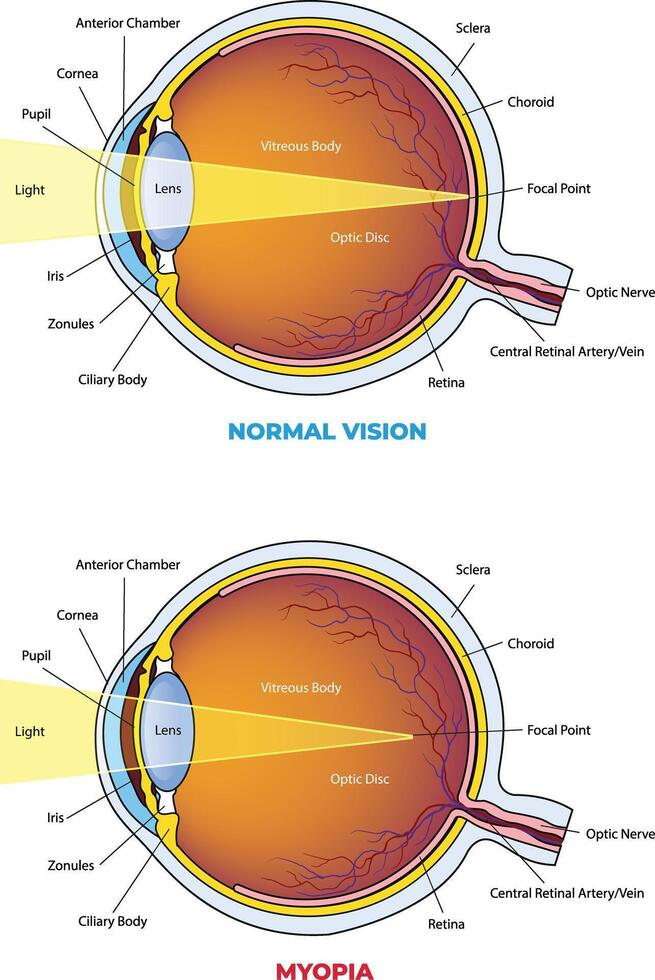
- Concave lenses, either in the form of spectacles or contact lenses, are used to shift the focus back onto the retina and restore clear vision.
- Concerns: As the axial length of the eye increases, the tissues of the eye, including the sclera, choroid, and retina, undergo stretching and thinning. This increases the risk of retinal detachment, myopic macular degeneration, glaucoma, and early cataract formation.
- High myopia, generally defined as a refractive error of −6 dioptres or greater, is associated with potentially irreversible visual impairment and blindness.
- Prevention: Research suggests that more outdoor time may help reduce progression risk.
- Regular eye exams are important, especially in school-age children.
Source: TH
Urban Heat Island
Syllabus: GS3/Environment
Context
- An intense heatwave across north and central India has highlighted concerns over the Urban Heat Island (UHI) effect.
What is an Urban Heat Island?
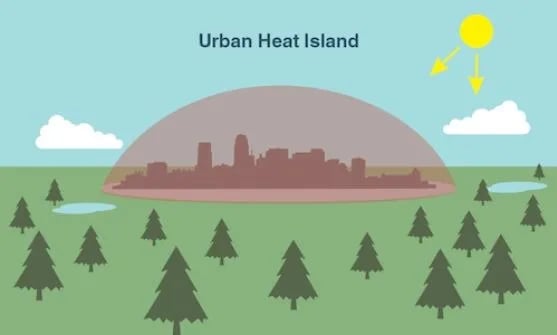
- An Urban Heat Island (UHI) is an area in which the temperature is higher than in surrounding rural areas due to human activities and infrastructure.
- UHI could lead to temperature differences of up to six degrees centigrade within a given area or neighbourhood.
Factors Responsible for Urban Heat Islands
- Built Environment: The materials used in urban construction, such as concrete and asphalt, absorb and retain heat, raising local temperatures.
- Reduced Vegetation: Urban areas typically have fewer trees and green spaces compared to rural areas, which reduces the cooling effect of shade and transpiration.
- Human Activities: Activities like transportation, industry, and energy consumption release heat into the environment, further elevating temperatures.
- Altered Surface Characteristics: Urbanization often involves replacing natural surfaces with artificial ones, which alters the surface reflectivity (albedo) and thermal properties, contributing to increased heat absorption.
Concerns
- Heat exhaustion and heatstroke, particularly among vulnerable populations.
- Energy Consumption: Increased demand for cooling, which escalates energy consumption and associated greenhouse gas emissions.
- Water Management: UHIs disrupt local water cycles by altering evaporation rates and reducing groundwater recharge.
Source: DTE
Previous article
75th anniversary of the Korean War
Next article
US-India Strategic Alliance, Global Influence: Rubio
